Website adviceBusiness websites
Local SEO for roofers: what to do in your first 30 days
Improve local SEO for roofers with accurate Google Business Profile details, useful service pages, real reviews and a practical 30-day work plan.

The short answer
Local SEO for roofers: what to do in your first 30 days
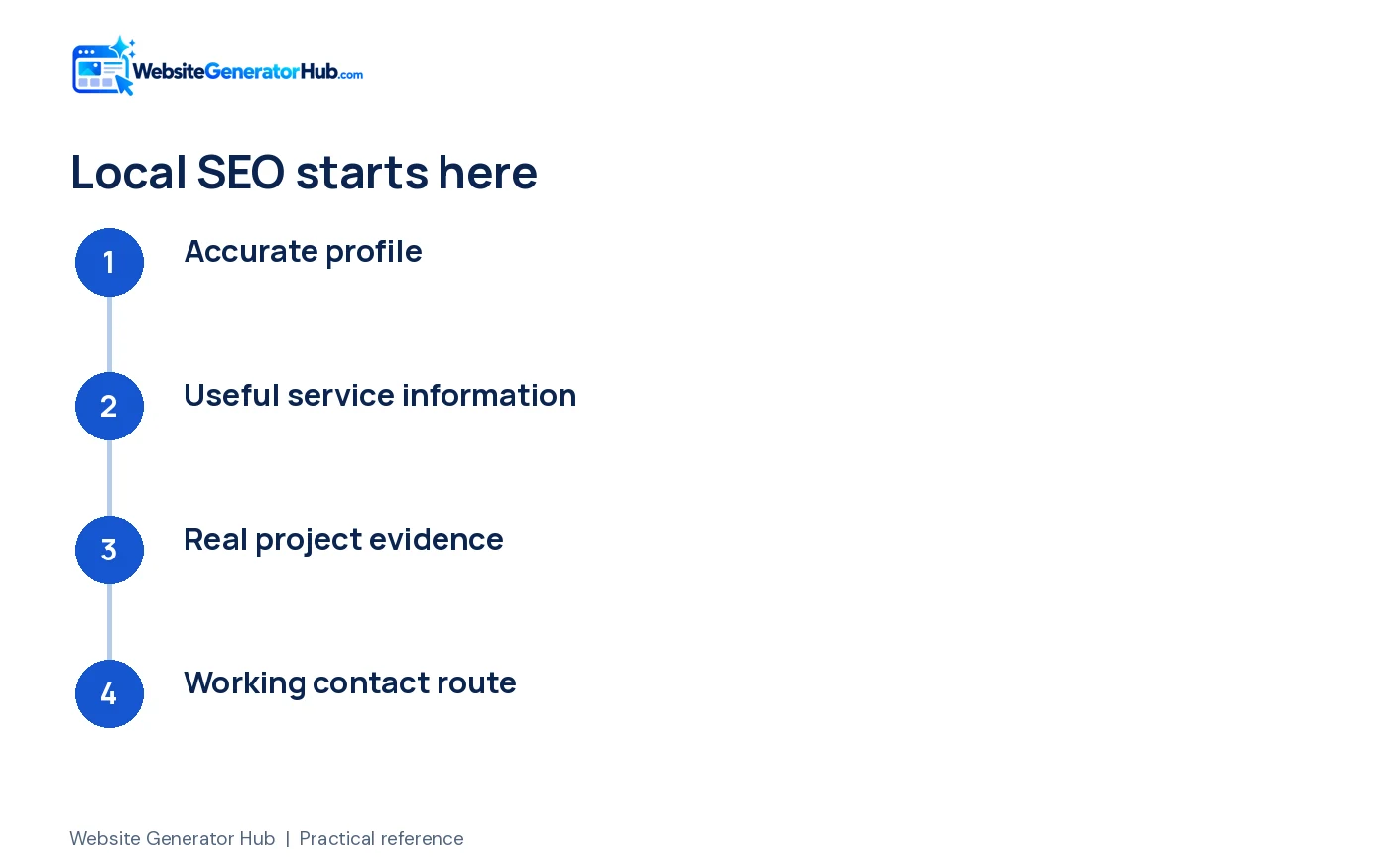
Local SEO for roofers starts with an accurate Google Business Profile, a website that clearly explains your work and location, and evidence from real projects and customers. Fix those foundations before creating dozens of town pages. Measure suitable calls and inquiries over time; a map position from one search is not the whole result.
What to remember
- Use your real business name, category and working locations.
- Give each important service enough useful information.
- Ask genuine customers for honest reviews without incentives.
My recommendation: Start with accurate business information, a useful service page and a working Google Business Profile. Track calls and qualified inquiries before expanding into more location pages.
- Use your real business name, category and working locations.
- Give each important service enough useful information.
- Ask genuine customers for honest reviews without incentives.
- Track inquiries alongside search visibility.
A homeowner searching for a leaking roof needs an answer quickly. Your job is to make it easy for that person to establish what you do, whether you cover the property and how to reach you. This guide focuses on work an owner can check and organize without buying a complicated SEO package.
What makes a roofer appear in local Google results?
Google says local results mainly depend on relevance, distance and prominence. You can improve how clearly you describe and substantiate the business, but you cannot control where a person searches from.
Google's local-ranking guidance explains why complete business information matters. It also says there is no way to pay Google for better local ranking. Paid advertising and organic visibility are different services.
For your business, relevance means making the actual work understandable. A company that repairs flat roofs should explain that service rather than relying on a generic statement such as “all roofing needs”. Prominence involves how well-known the business is, including signals such as links and reviews.
Treat the search results as several possible routes. A customer might find a map listing, a service page, an image or an independent directory. The page they reach should help them act without hunting for basic information.
Start a baseline before changing anything. Record the website URL, profile details and current inquiries from search. Save dates of important updates. That will help you distinguish a correction from normal fluctuations caused by weather or the season.
Which business details deserve attention first?
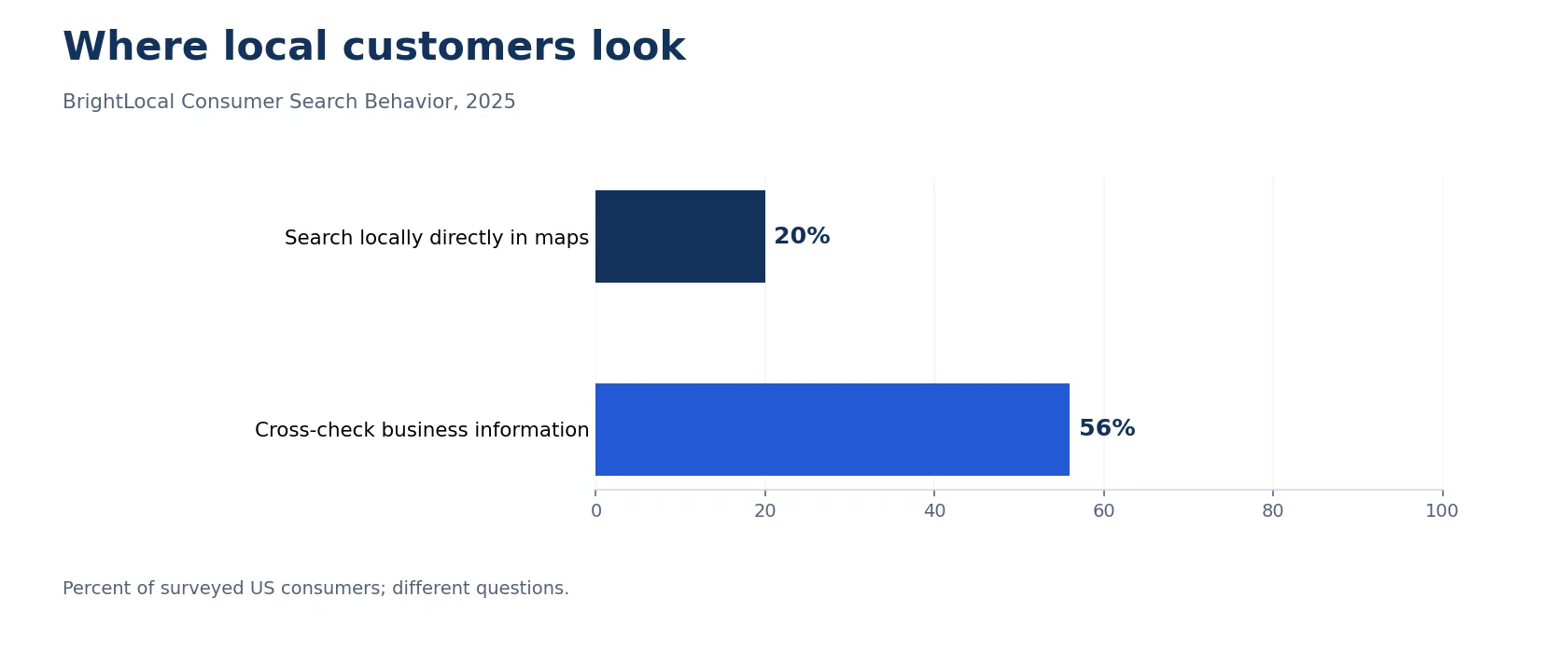
BrightLocal’s 2025 survey of 1,000 US consumers found one in five searched locally directly in maps, while 56% checked business information against other online mentions. Treat the business profile and website as connected sources of facts rather than separate campaigns. Source: BrightLocal Consumer Search Behavior 2025.
How should you set up a roofing business profile?
Use the business as it exists in the real world. Claim the correct profile, follow the verification process Google presents and keep ownership under an account your business controls.
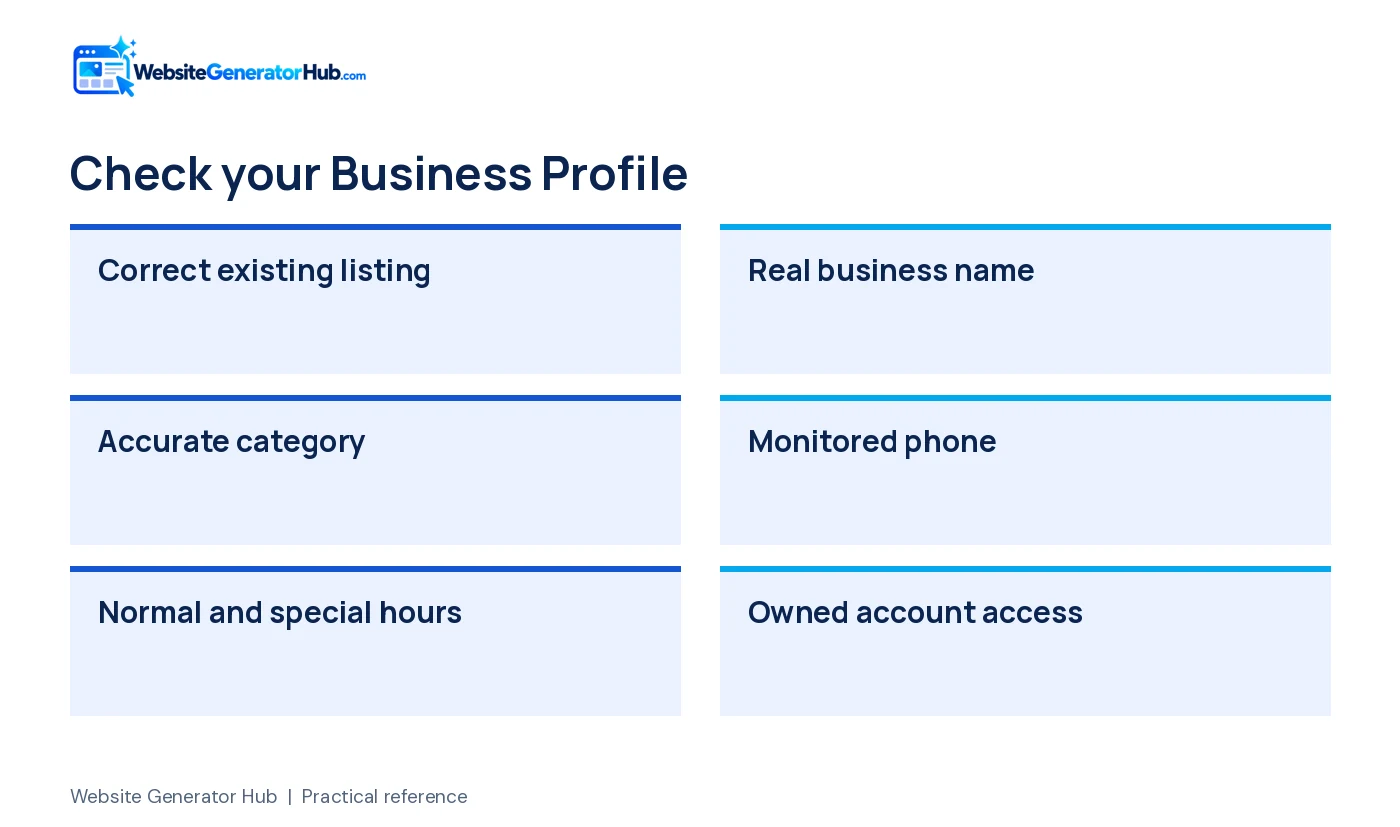
Check these items in order:
- Search for your business name to see whether a profile already exists.
- Claim the correct listing rather than creating a duplicate.
- Use the name customers see on your branding and documents.
- Choose the most accurate primary category available for the business.
- Add a phone number you monitor and the correct website URL.
- Set normal hours and review special hours before holidays.
- Add relevant photographs of the team, vehicles and completed work where you have permission.
Google's representation guidelines require accurate names and locations. Adding a string of towns and services to the business name is not a substitute for good content. Nor should a virtual office be presented as a staffed local branch when it is not one.
Keep a private record of the account owner, authorized managers and recovery arrangements. If an agency helps you, your business should still know who controls the listing. Never publish account credentials or verification material on the website.
Should a roofer show a home address or service area?
A roofer who travels to customers and does not receive customers at the business address should configure a service-area business appropriately. A public website does not need to expose a private home address merely to look local.
Google provides separate address guidance and service-area settings. The latter allows up to 20 areas based on places such as cities and postal codes. Select the places you really cover rather than filling every available slot.
The website can state the main town and nearby places in clear contact copy. For example, “Roof repairs in Austin and nearby towns” is useful only if it reflects your actual working area. If you travel farther for larger commercial projects, explain that distinction rather than suggesting every job is available everywhere.
Adding an area to a profile does not create a new office or guarantee visibility there. Avoid opening a second profile just to target another town unless that location independently qualifies under Google's rules.
What should a roofing service page say?
A service page should answer the practical questions about that particular job. Explain what the service covers, when to inquire, how you assess it and what information helps you prepare a quote.
For roof repairs, useful subjects include the roof types you work on, how you investigate the problem and the limits of a remote estimate. For replacement work, explain the survey, material discussion, access planning and final handover. Do not turn general advice into a diagnosis of a visitor's roof.
Use ordinary language that matches your market. US visitors may search for roof inspections, shingles, storm damage and gutters. The best wording is the wording your own customers use when describing the work you actually do.
Write a descriptive page title. Google's title guidance recommends concise, distinct titles and discourages repeated keyword strings. “Flat roof repairs in Austin | Business name” communicates a topic more clearly than a list of ten towns.
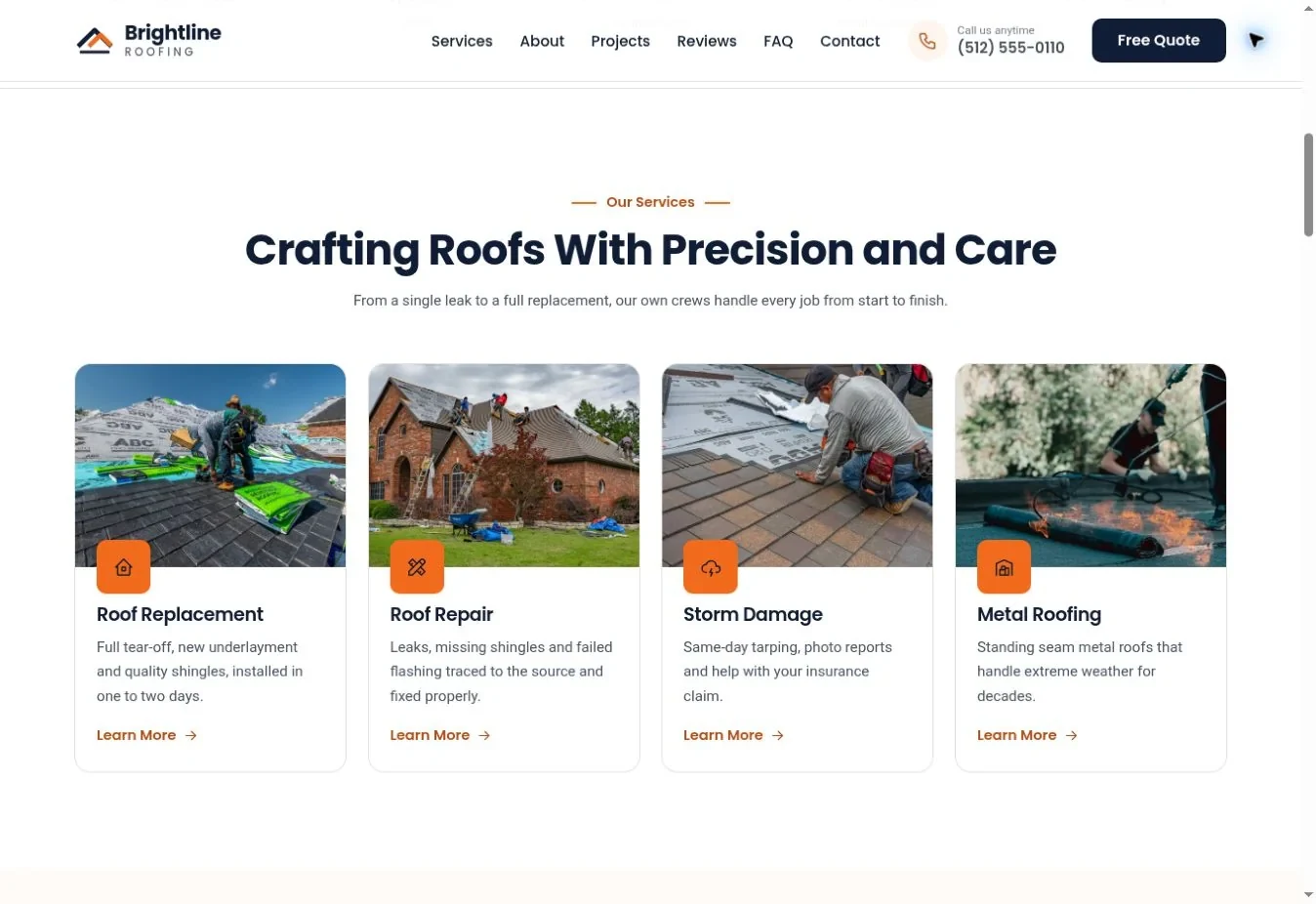
Photographs should support the explanation. A caption might name the roof material and describe the task without identifying a customer's exact address. Include useful alternative text for informative images, and keep contact information as selectable text rather than part of a picture.
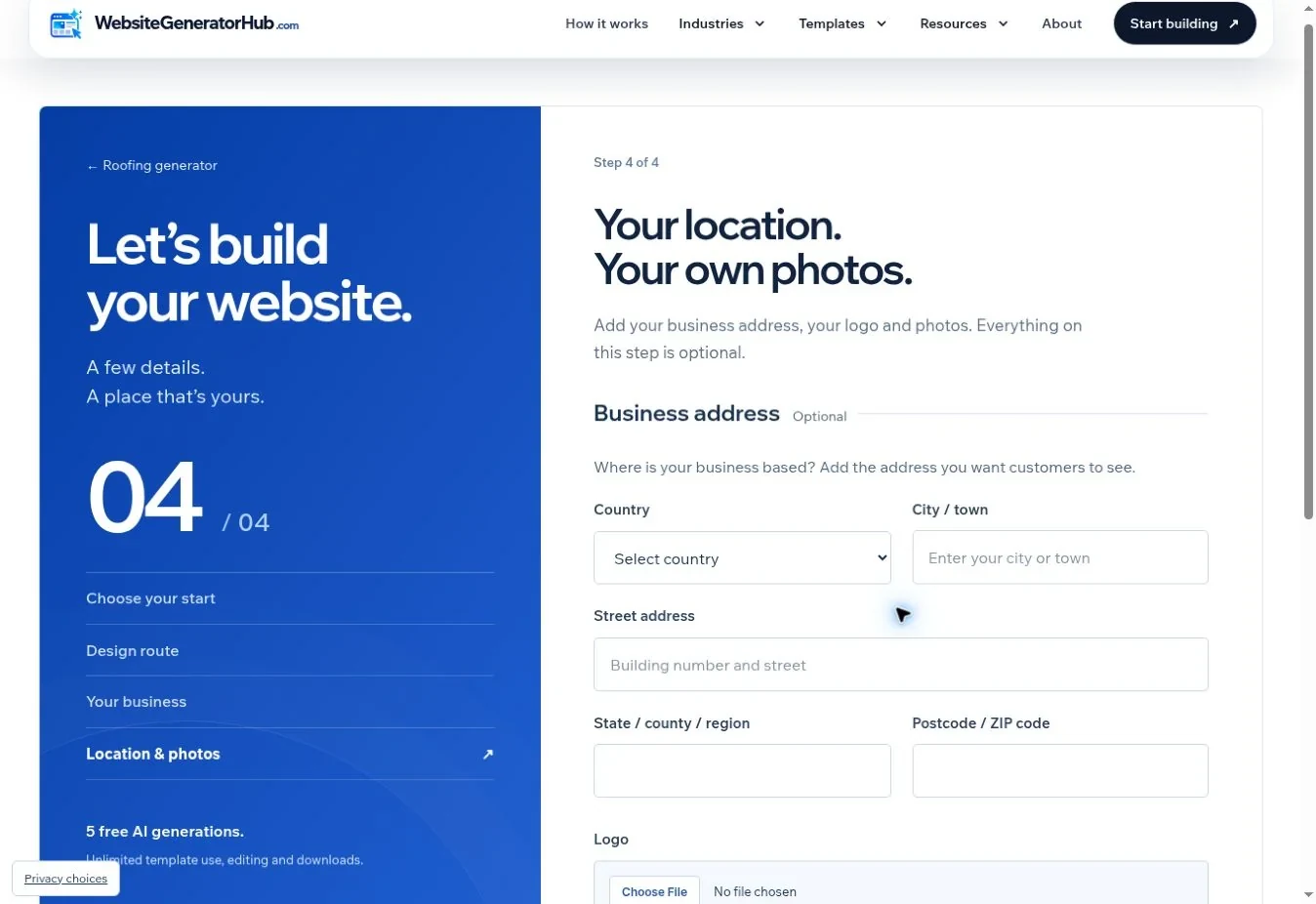
If you are starting with a one-page site, organize the services clearly first. You can move a detailed service into its own page later. The roofing website generator gives you a starting layout; the website editing guide explains the review stage.
Do you need a separate page for every town?
No. Create a town page when you have something useful and distinct to say about working there. A list of near-identical pages with swapped place names is weak evidence and can create search-quality problems.
A useful local page might include a relevant project, a real limitation on access, the kinds of property you commonly work on and answers to questions from customers in that area. It should help a reader who lands directly on it.
Google's spam policies address doorway abuse, including pages made to rank for similar searches and funnel people onward. The point is not to avoid all location pages. It is to avoid producing pages whose only distinction is a keyword.
Start with the locations that matter commercially. Ask whether you can answer a question there better than on the main service page. If not, a clear coverage statement may be enough until you have more genuine information.
Keep the town-page link structure useful. A visitor should be able to reach the relevant service and contact details without moving through a chain of thin pages. The roofing design checklist covers the information customers should find easily.
How should reviews and local links support the site?
Reviews should come from real customers, and local links should reflect real relationships. Both are more useful when they help someone independently understand your business.
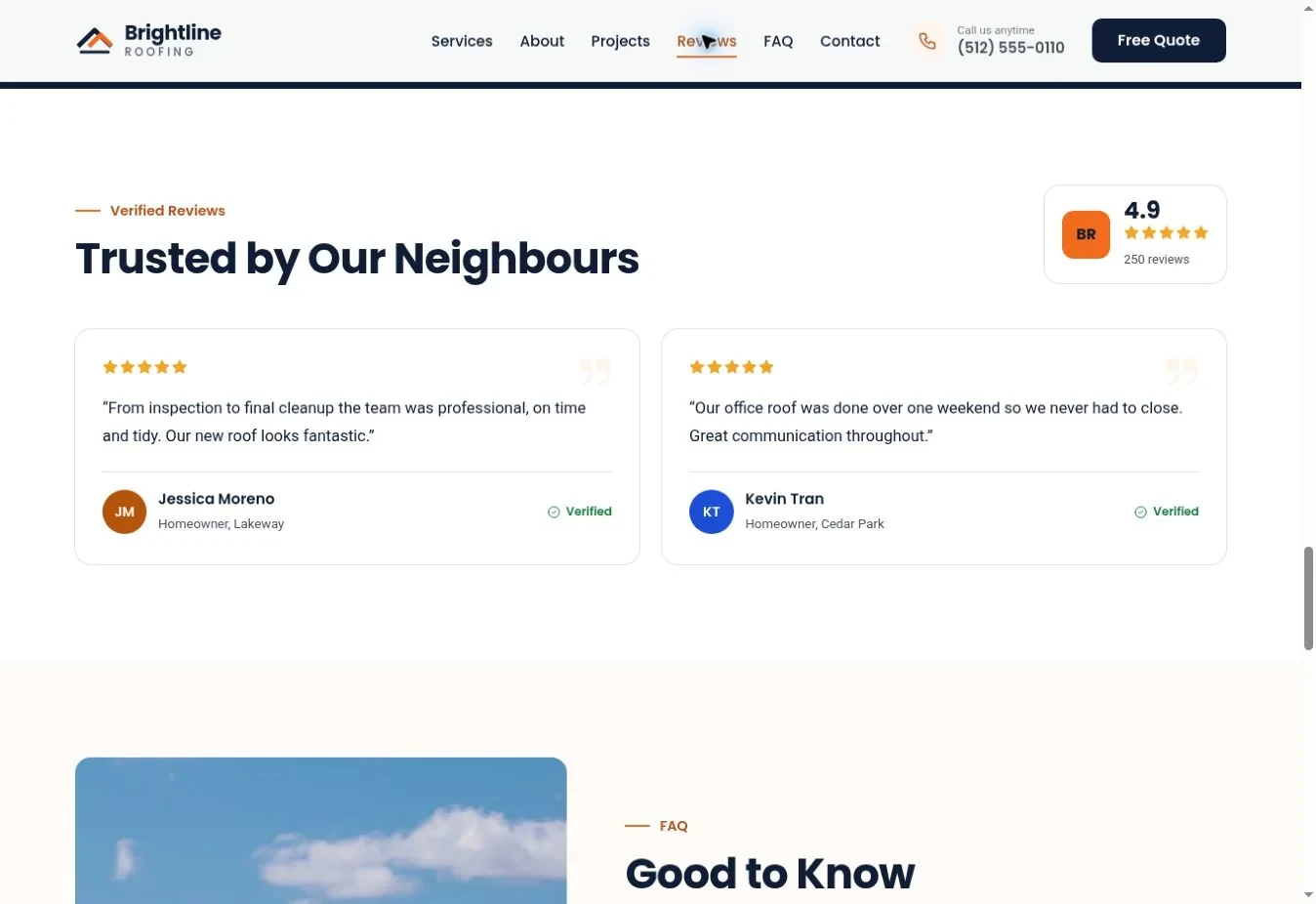
After a completed job, send a neutral request for an honest Google review. Use the same process for customers generally, not only those you expect to give five stars. Google prohibits incentives and selective positive-review solicitation in its review policies.
For links, begin with legitimate listings and relationships: a relevant trade organization, an authorized manufacturer directory or a local association where you are actually a member. Verify the destination and contact details. Do not pay for hundreds of unrelated directory submissions because a report promises a high link count.
If you publish a project story, give it substance. Explain the job, constraints and result in terms the customer permits you to share. Avoid invented testimonials or claims that an image proves something it cannot show.
Our Google reviews guide includes request wording and a process for checking displayed reviews. Keep review collection separate from making an unhappy customer resolve a complaint privately before they can leave feedback.
Which technical checks matter first?
First check that customers can use the site and search engines can access the intended public pages. A technically elaborate site with a broken form is not doing its job.
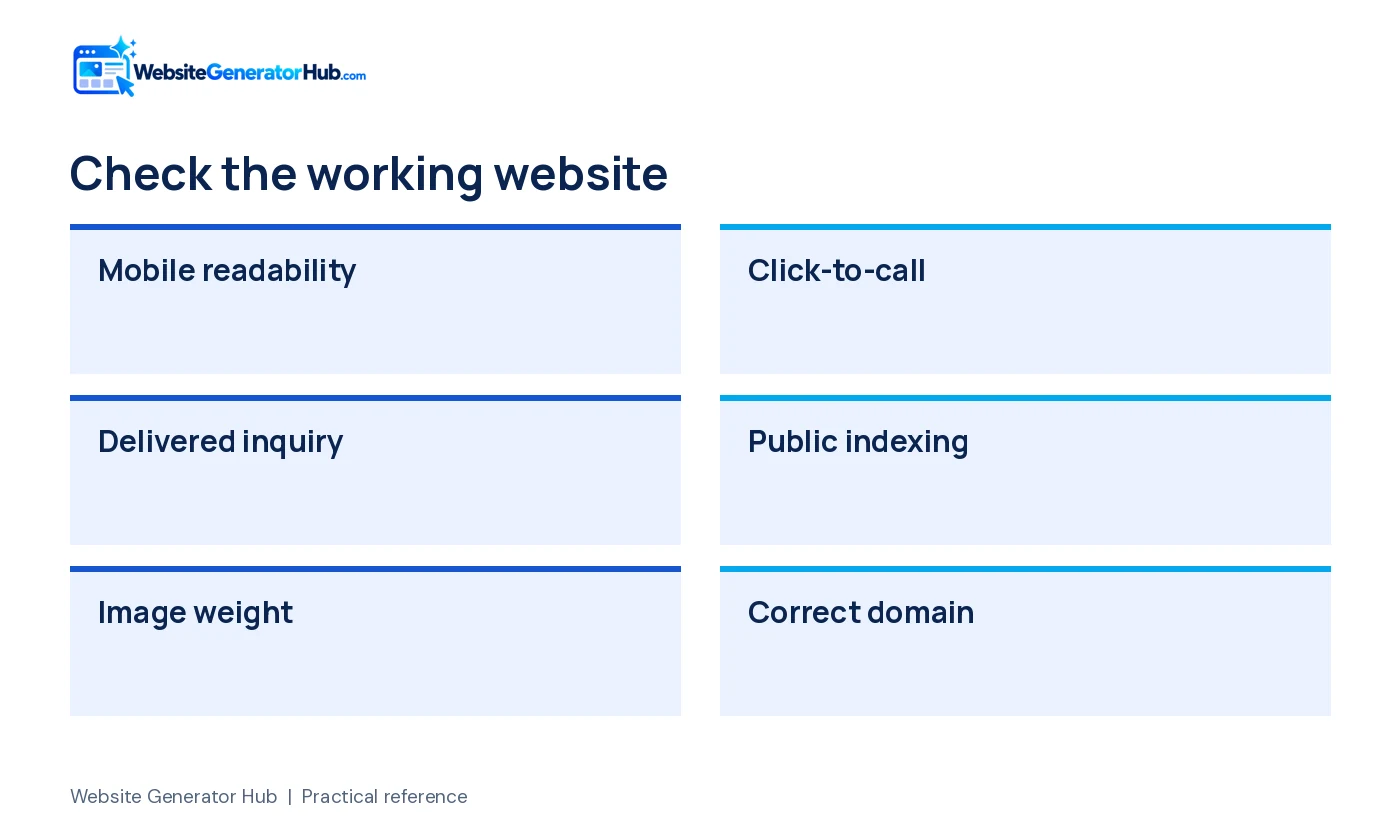
Open the site on a phone using a normal mobile connection. Check the text, image sizes, menu and contact controls. Then submit a test inquiry and confirm that it reaches the intended inbox. A success message alone does not prove delivery.
Use Search Console to inspect important URLs and submit the sitemap. Check whether the public site is accidentally marked noindex. Keep private previews out of the public index, and ensure the final domain is the one you promote.
For performance, Google's Core Web Vitals guidance gives good-experience thresholds of LCP within 2.5 seconds, INP at most 200 milliseconds and CLS at most 0.1, measured at the 75th percentile. These are diagnostic targets, not a promise of a particular ranking.
Compress large photographs, give images dimensions and avoid unnecessary scripts. If a tool flags a problem you do not understand, record the affected URL and ask for a specific explanation rather than purchasing a vague “speed boost”.
What can you complete in the first 30 days?
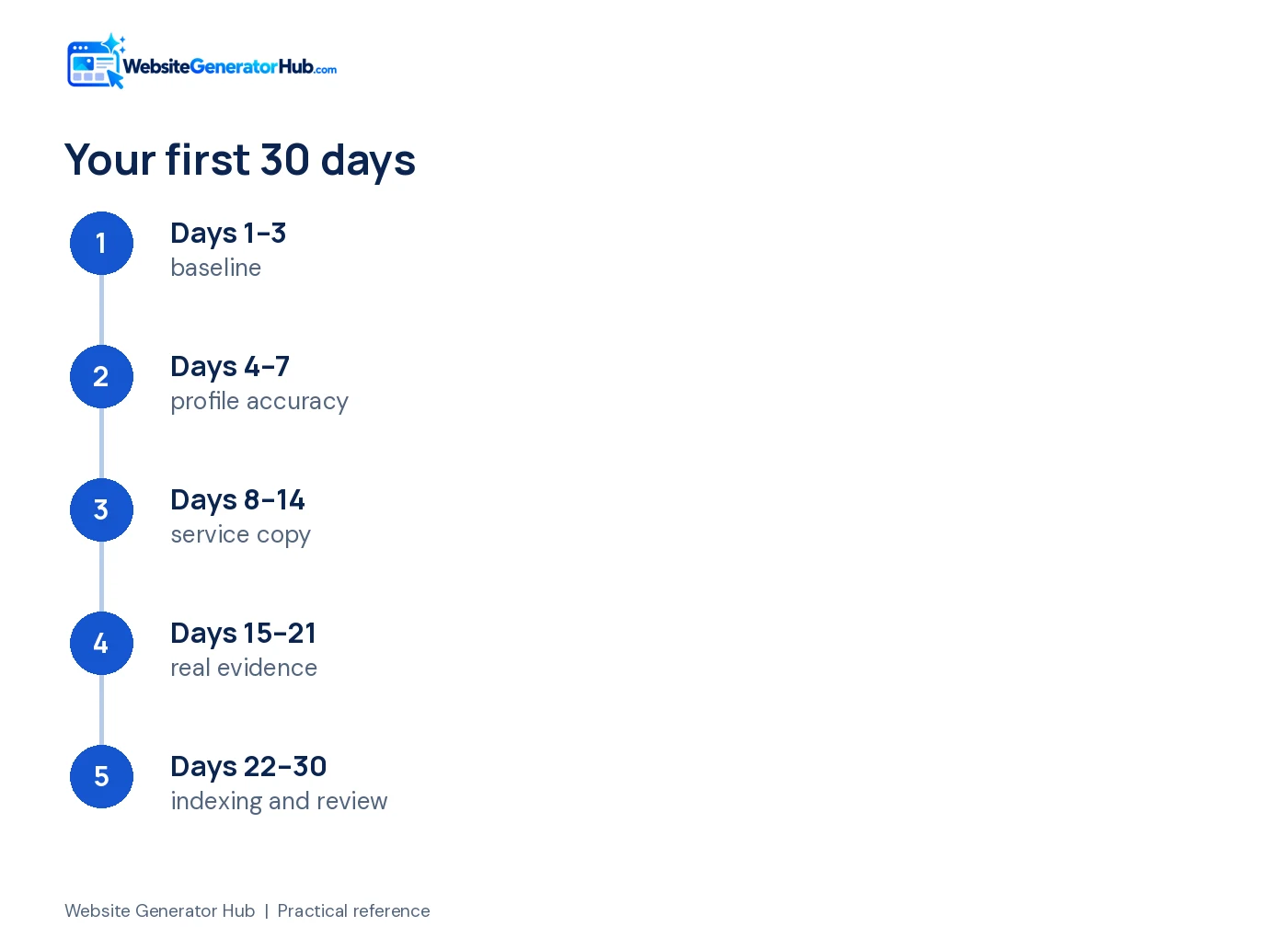
You can establish a reliable baseline and fix the most important gaps in a month. The timetable below is a work plan, not a promise that rankings will change within 30 days.
| Period | Work to complete | Evidence to keep |
|---|---|---|
| Days 1–3 | Verify contact details, profile ownership and website access | Baseline screenshots and inquiry log |
| Days 4–7 | Correct category, hours, website link and service coverage | List of corrections and dates |
| Days 8–14 | Improve the main services and contact page | Final copy and tested inquiry receipt |
| Days 15–21 | Add permissioned project evidence and review requests | Photo permissions and request process |
| Days 22–30 | Check indexing, mobile use and legitimate local listings | Search Console notes and next actions |
Set a recurring review after this first month. Look at the search queries bringing impressions, the pages receiving visits and the inquiries the business can actually serve. Improve one meaningful weakness at a time.
How does this relate to AI search?
Clear business information and useful public pages can help people and search systems understand the business. There is no setting that guarantees a recommendation from an AI assistant.
Google's current generative-search guidance builds on ordinary SEO principles. Keep claims specific, sources visible and business facts consistent. Do not add invented statistics or repetitive FAQs simply because someone says an AI system prefers them.
Useful FAQ content can still answer customers' questions. However, Google's documentation now records that FAQ rich results are no longer displayed. Do not measure success by expecting FAQ dropdowns to appear under every search result. The AI visibility guide explains how to set more sensible expectations.
Frequently asked questions
How long does local SEO take?
There is no reliable universal deadline. Correcting a phone number may help customers immediately, while search visibility depends on competition, location, indexing and the quality of the wider business presence. Keep a dated work log and review comparable periods. Be cautious of a provider promising a fixed map position by a fixed day.
Can I rank in a town where I have no office?
You can explain services you genuinely provide in that town, but you should not invent an office or create an ineligible profile. Search visibility depends on more than the towns you list. Useful project evidence and clear service information are better foundations than a fake address or duplicated location pages.
Do I need to add “near me” everywhere?
No. Use normal wording that explains the service and actual location. Repeating “near me” across headings and paragraphs makes the page awkward without changing where the customer is. A useful title, accurate profile and clear local details are more sensible than forcing the phrase into every section.
Should I remove a negative review?
You can report a review that violates Google's policies, but disagreement alone is not a reason for removal. Respond calmly, avoid publishing private job details and offer a practical way to discuss the issue. Never offer payment or a discount in return for changing or deleting a review.
Is a one-page roofing website bad for SEO?
A one-page site can explain a small business clearly and be indexed. It becomes limiting when several services need detailed, different answers. Start with useful information and a working inquiry process. Add pages when they serve a real customer need, rather than assuming more URLs automatically produce better rankings.
Do I need a monthly SEO contract?
Not every roofer needs one immediately. You can complete many accuracy and content checks yourself. Professional help becomes useful when you have technical issues, several locations or a clear growth plan. Ask for defined deliverables, account access arrangements and reporting tied to business outcomes before agreeing to recurring work.
Begin with the information a customer can verify today. Create your roofing website, check the details against your listing and test the contact route before you promote it. Then use the 30-day plan to build evidence steadily.
Sources & further reading
Sources checked .
- Improve local ranking (opens in a new tab)support.google.com
- Represent your business (opens in a new tab)support.google.com
- Service areas (opens in a new tab)support.google.com
- Address guidance (opens in a new tab)support.google.com
- Title links (opens in a new tab)developers.google.com
- Spam policies (opens in a new tab)developers.google.com
- Review policies (opens in a new tab)support.google.com
- Web Vitals (opens in a new tab)web.dev
- Google AI search optimization guide (opens in a new tab)developers.google.com
- Google Search documentation updates (opens in a new tab)developers.google.com
- BrightLocal Consumer Search Behavior 2025 (opens in a new tab)www.brightlocal.com