Website adviceBusiness website guides
How much does a roofing website cost in 2026?
Compare roofing website costs, free templates, paid builds and renewal bills. Use a practical quote checklist to choose the right scope for your business.


The short answer
How much does a roofing website cost in 2026?
A roofing website can cost nothing to design and download, while a custom project can run into thousands of dollars. The useful comparison is the total cost of a working website: design, content, domain, hosting, inquiry delivery and maintenance. Decide what you need before comparing headline prices.
What to remember
- Separate the initial build from recurring bills.
- A free template can be enough for a small roofing business with straightforward inquiries.
- Custom integrations, original copy and migrations increase the work involved.
My recommendation: For a roofer who needs calls and quote requests, start with a complete template and pay only for the launch work you cannot handle. Commission a custom build when you need integrations, multiple locations or a genuinely different customer journey.
- Separate the initial build from recurring bills.
- A free template can be enough for a small roofing business with straightforward inquiries.
- Custom integrations, original copy and migrations increase the work involved.
- Compare written deliverables and renewal terms, not the number of pages alone.
Compare the written scope of a paid proposal with the tasks you would handle yourself after a free download. This guide helps you inspect the difference without assuming that an expensive website will bring more jobs.
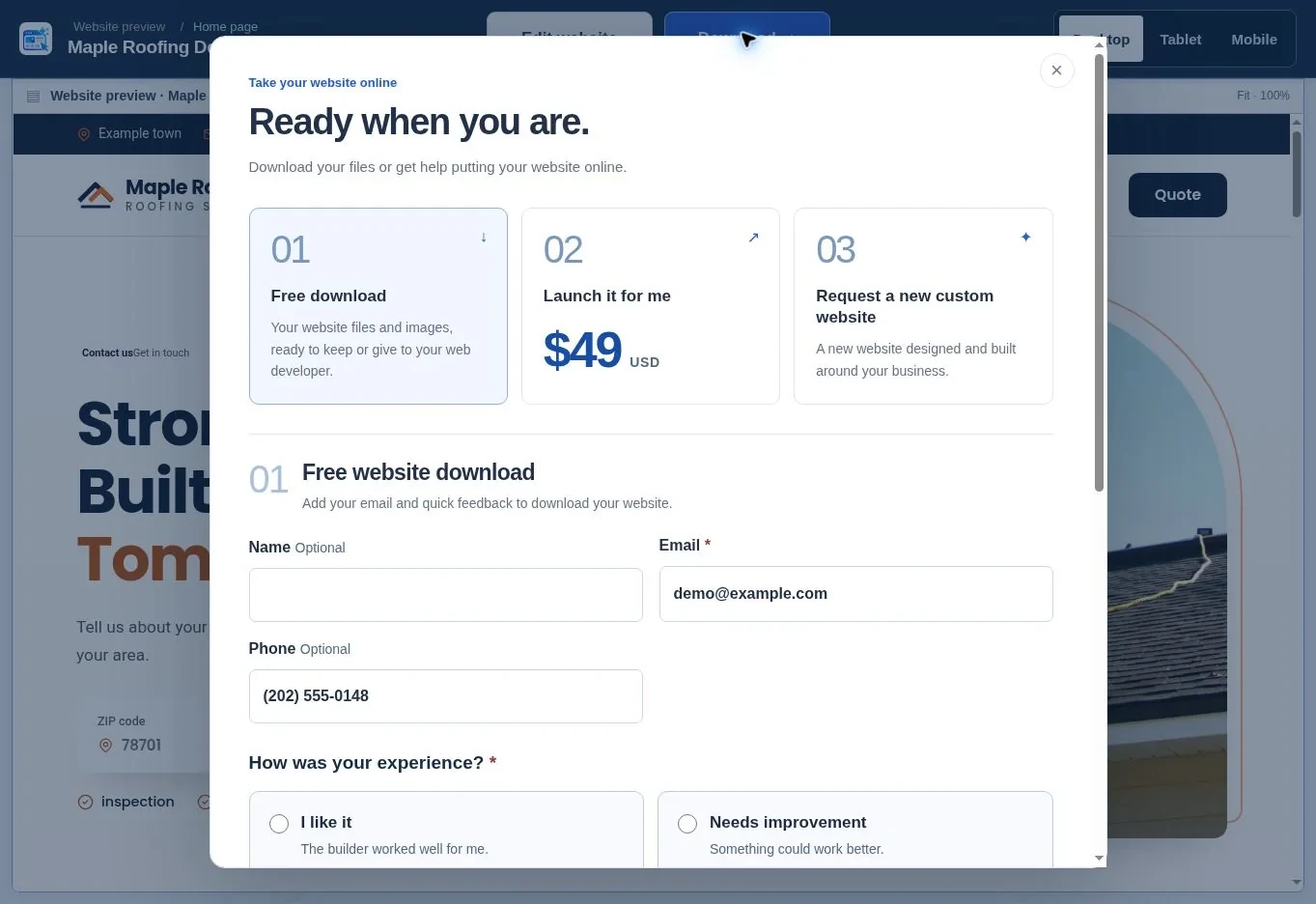
From my web development work: When I planned Website Generator Hub’s launch service, I separated two requests: putting files on a customer’s existing hosting, and supplying a domain and hosting as well. The page design can be identical while the work differs. Ask which of those jobs a website quote actually includes.
What does a roofing website actually cost?
There is no single verified industry-wide price for a roofing website. Public offers include free design tools, subscription builders and individually quoted services. Start with the route you want to take, then request the missing costs.
| Route | What you pay for initially | Costs to check afterward | Best fit |
|---|---|---|---|
| Free downloadable template | WebsiteGeneratorHub template use, editing and download are $0 | Hosting, domain, email delivery and optional help | Owner who has accurate content and can arrange hosting |
| Hosted DIY builder | The selected subscription and any setup help | Plan renewal, domain renewal, paid applications | Owner who wants the builder and hosting in one account |
| Freelancer | Agreed design, content and implementation work | Hosting, updates and future changes | Business needing help with a clearly defined scope |
| Agency | A scoped project, sometimes including research and migration | Support, marketing retainers and third-party software | Larger operation with more stakeholders or integrations |
These are purchasing models, not equivalent packages. Wix's pricing page, for example, separates free creation from paid plans and says the final price is shown before purchase. A local checkout can differ by currency, taxes, term and promotion. Record the amount actually payable rather than copying an old monthly figure from a comparison post.
WebFX's published cost guide shows how widely professional web projects vary. It covers many kinds of websites, so it should not be treated as a survey of roofers. Your own quote is more useful when it states exactly what gets delivered.
Which essentials deserve space in the budget?
BrightLocal’s 2025 US survey: 85% valued contact details/hours; 67% often or always checked reviews after local searches. Source: BrightLocal Consumer Search Behavior 2025.
Fund accurate business information and a usable contact path before decorative extras. These findings describe local-business research generally, rather than a roofing-only spending study.
Which numbers belong in your launch budget?
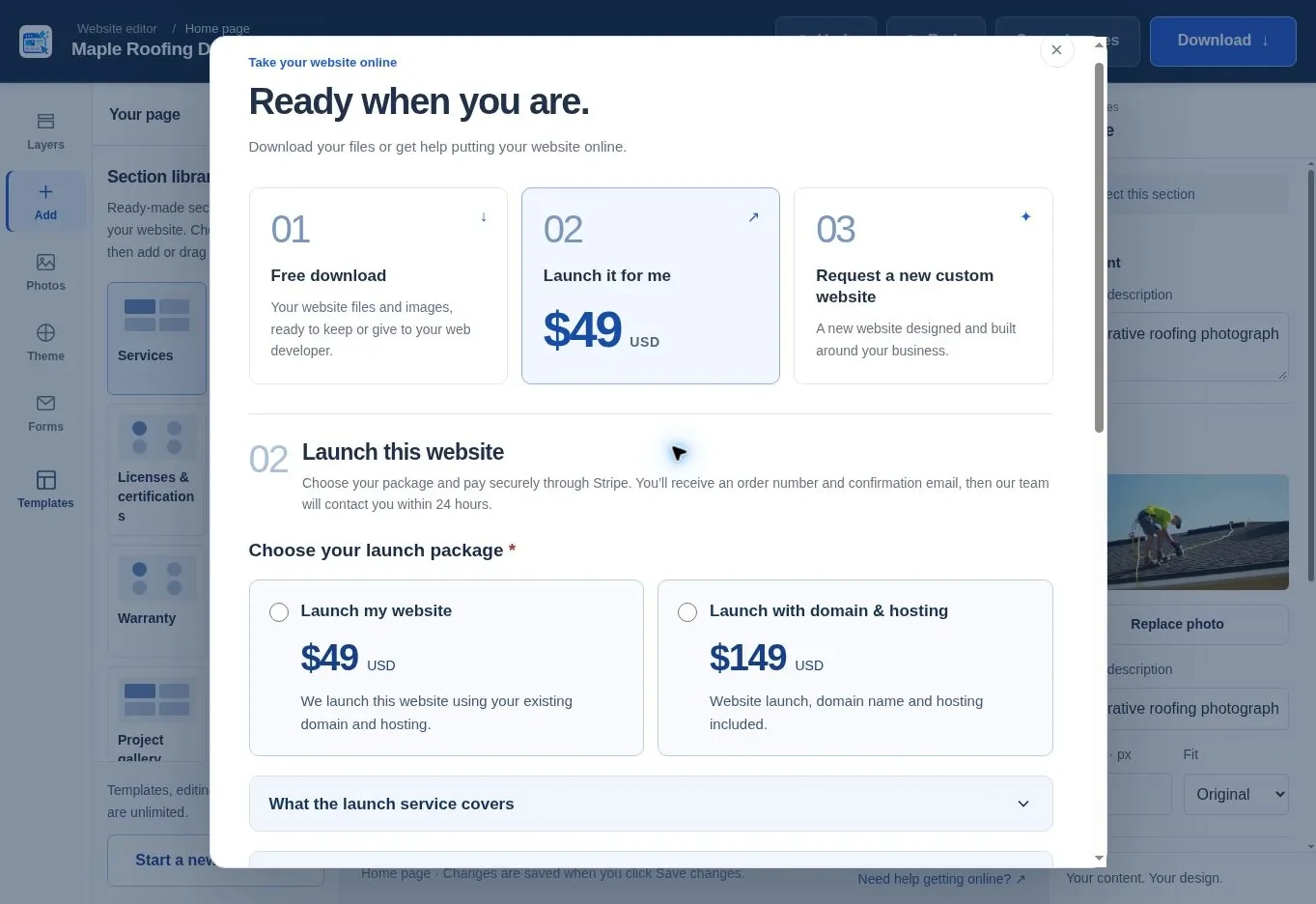
Our published launch options are $49 USD with an existing compatible domain and hosting, or $149 USD including the specified setup. The latter includes 12 months of hosting and one year of an eligible standard-priced domain. Renewal is a separate cost. Compare that defined launch scope with any custom-design proposal. Source: WebsiteGeneratorHub: Terms of Use.
What do you get free with WebsiteGeneratorHub?
You can preview, edit and download the ready-made roofing templates without a template-use limit. AI generation has a separate five-request allowance, including regenerations, shared with HVAC in your browser; failed generations are returned to that allowance.
The free part is the website creation and download. Publishing on your own domain still needs suitable hosting. Keep the required linked platform credit in a free download, and check the current FAQ before choosing a workflow.
Optional launch help is listed at $49 USD when you already have compatible hosting and a domain. Under the published launch terms, the $149 USD package includes launch, 12 months of hosting from go-live and one year of registration for an available, standard-priced .com, .net or .org domain. Premium, aftermarket and reserved domains are excluded. Later hosting and domain renewals cost extra: a renewal quote is sent at least 30 days before expiry, with renewal proceeding only after your approval and payment. The package does not include lifetime hosting.
Launch help publishes the selected one-page website, connects one domain and HTTPS, and checks page and inquiry-form setup. A new design, extra pages, content rewriting, migrations and ongoing maintenance are separate. This distinction prevents a small launch package from being mistaken for a complete marketing service.
Which costs are easy to miss?
Domain renewal, hosting renewal and the work needed to keep inquiries arriving are easy to miss because they are separate from the design. Add them to the budget before selecting a supplier.
Domain. Check the renewal price, who owns the registration, who can access the account and how renewal notices reach you. A first-year promotion does not tell you what the next year costs. Register the domain in the business's control, not an unrelated supplier's personal account.
Hosting. Ask whether the advertised figure is billed monthly or requires several years upfront. Check backups, restore access, HTTPS and the server features your downloaded website needs. A static page appearing online does not prove that a PHP inquiry endpoint can run there.
Email. A mailbox, a sending service and a form recipient are different things. Test the final website with an external email address and confirm that the office receives the message. Include reply handling and spam protection in the handover.
Maintenance. Decide who will update opening hours, remove expired offers and restore a broken page. If you pay a retainer, ask how many changes it covers and how quickly requests are handled. If you maintain the site yourself, put a recurring check in your calendar.
Content and photography. Someone must select job photos, obtain permission and write accurate descriptions. A supplier may quote for design while expecting you to provide every word. Find that out before the project starts.
How can you compare the first year and later years?
Use one total-cost worksheet with the same time period for every option. Separate a first-year discount from the recurring amount so the cheapest opening offer does not hide a larger long-term commitment.
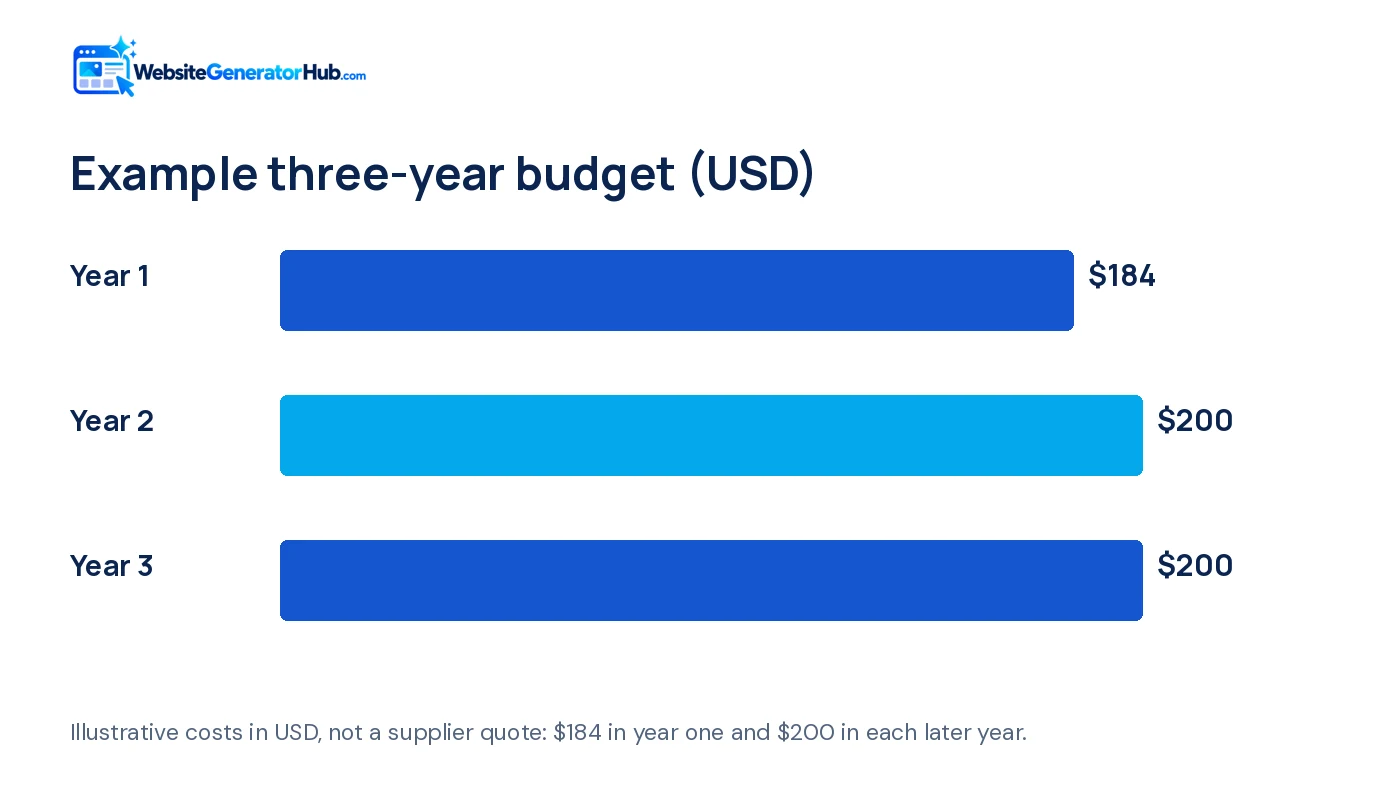
The example below is a calculation, not a supplier quote or market average. Replace each assumption with the figures in your offer.
| Illustrative item | First year | Each later year |
|---|---|---|
| Template design | $0 | $0 |
| Domain assumption | $15 | $20 |
| Hosting assumption | $120 | $180 |
| Launch assistance assumption | $49 | $0 |
| Total, excluding tax and other services | $184 | $200 |
Under those assumptions the three-year cost is $584: $184 plus two years at $200. It would be wrong to describe this as a guaranteed WebsiteGeneratorHub package price; the hosting and domain figures are deliberately illustrative.
Add email, paid tools or support if you need them. Also record your own hours separately. Time spent preparing photographs and checking service descriptions has a cost even when no invoice arrives.
What makes a roofing website quote more expensive?
The price rises when the work becomes more specific, more integrated or harder to migrate. A ten-page site using one repeated layout may take less work than a carefully built one-page website with custom interactions and a CRM connection.
Roofing-specific work can include organizing before-and-after projects, writing separate repair and replacement copy, describing different materials, and explaining storm-damage assistance accurately. Several office locations add contact details, routing and content checks. Moving an established site adds redirects and the risk of losing useful pages.
A photo gallery is also more than an empty grid. Ask who will crop images, write captions, avoid exposing a customer's house number and check the layout on a phone. If you have 80 project photos in different formats, preparation can become a meaningful part of the job.
Integrations need a written definition. “CRM integration” could mean a link to another page, a working lead submission, or two-way scheduling with status updates. Those are different projects. Include the exact destination, required fields, failure handling and test evidence in the agreement.
For a simple starting point, preview the free roofing templates. Compare an actual layout with your brief before paying for changes you may not need.
When is a free roofing website enough?
A free template is a sensible starting point when you need a clear introduction, service descriptions, project photos and a reliable way to contact you. It works best when you can supply the facts and someone is responsible for publishing and checking the result.
Consider a small crew that gets inquiries through referrals. Its immediate needs may be a phone number, a few genuine jobs, working hours and a request form. A large content program is a separate decision; the crew can start with a complete page and improve it as real questions arrive.
Choose more specialist help when the business needs multiple locations, complex booking, a content migration, accessibility remediation or connections to office software. Paying for that work can make sense. Paying for a longer homepage without a clear business purpose is harder to justify.
Use the roofing website design checklist to assess function, and the AI versus template guide to choose a starting point.
What should you ask before accepting a quote?
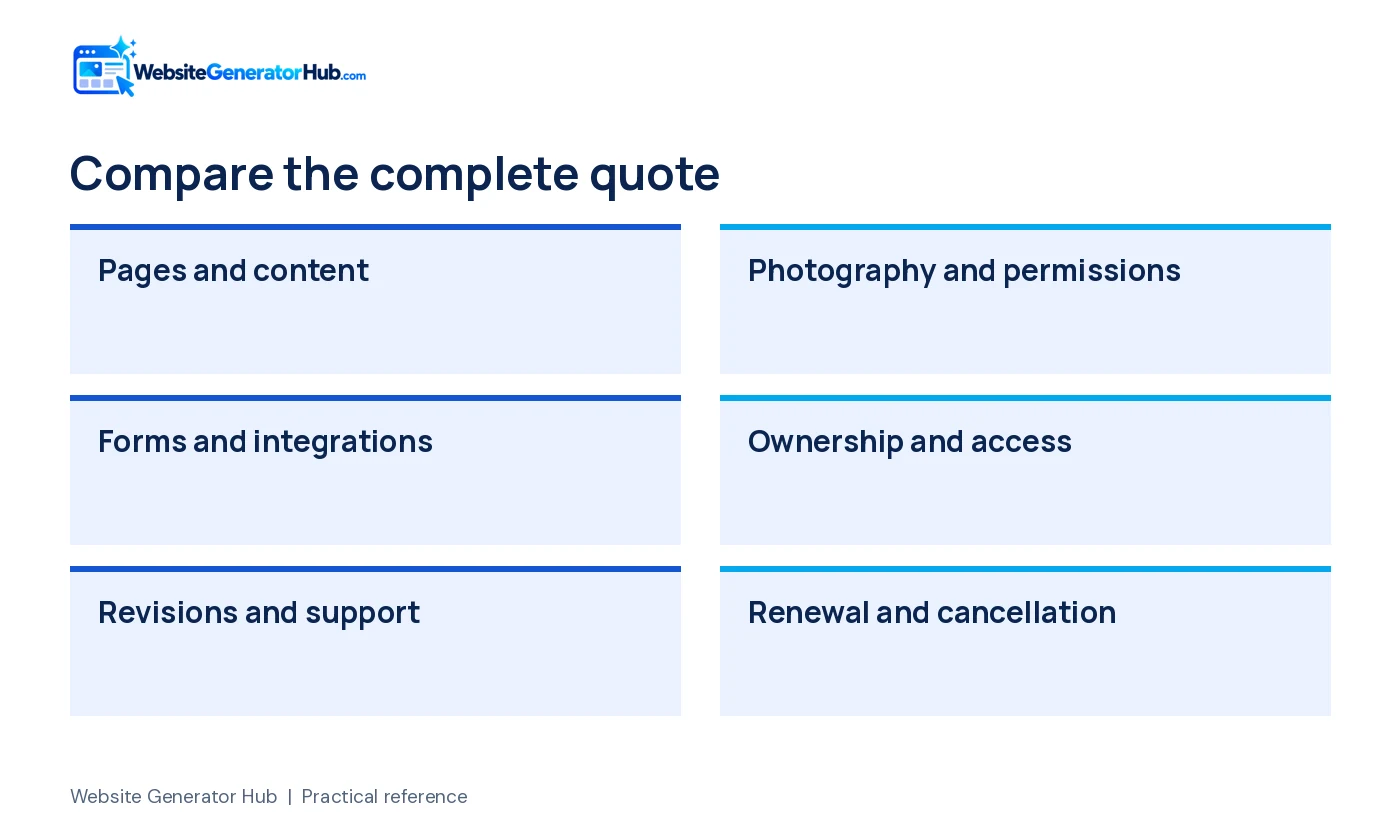
Ask the supplier to turn broad promises into deliverables that you can inspect. A short written scope makes both the price and the handover easier to assess.
- Which pages or sections are included, and who writes them?
- Who supplies photographs, logos and verified customer reviews?
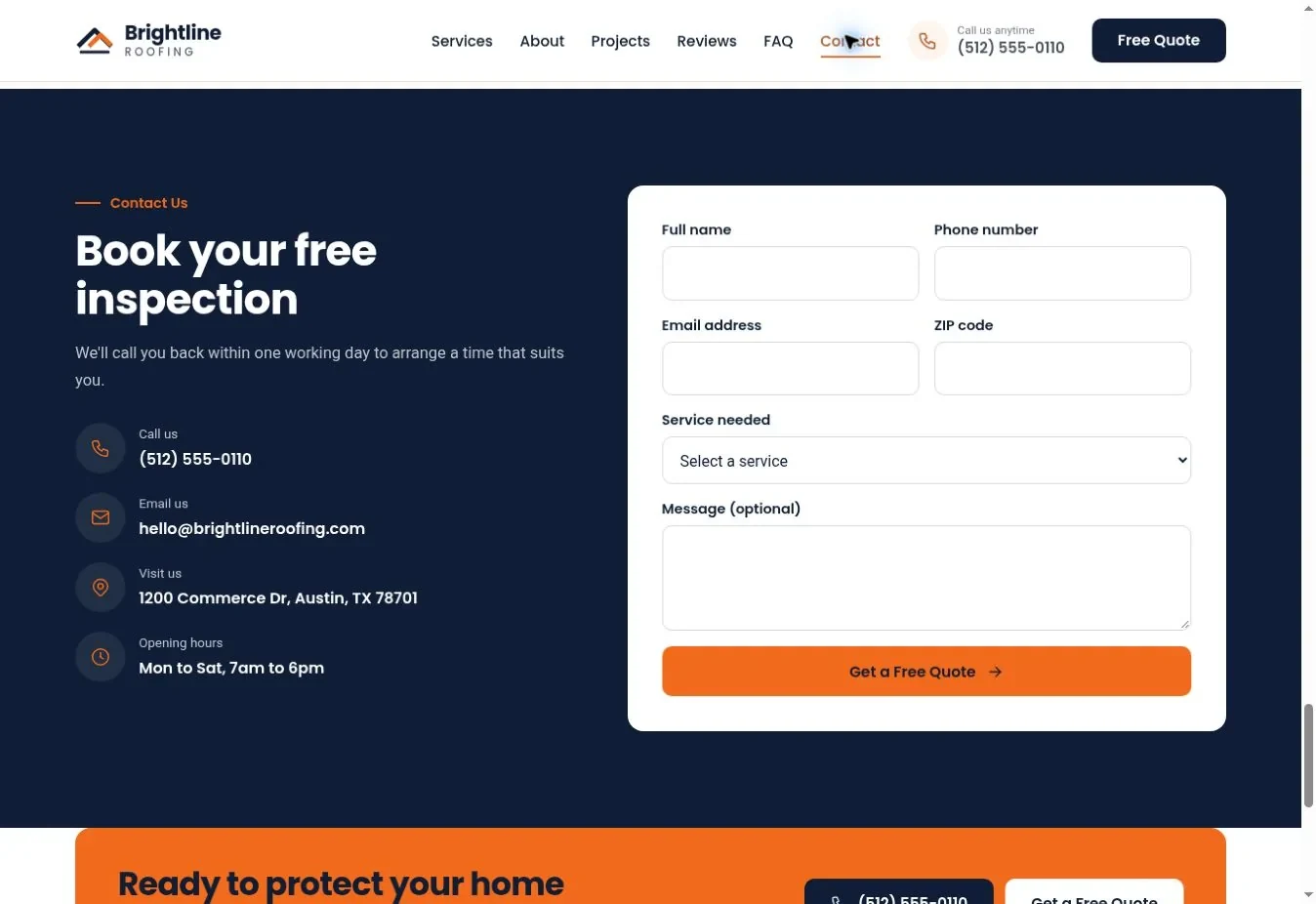
- Which forms will be connected, and how will delivery be tested?
- What accounts and files will the business control after payment?
- What revisions, support and maintenance are included?
- What will renewal, cancellation and future edits cost?
- How will existing URLs and inquiries be protected during launch?
Ask for one relevant example and look at it on a phone. Try the menu and the form. You can also run PageSpeed Insights on the example, but do not judge the whole supplier by one laboratory score. Google distinguishes loading, interaction and visual stability; the Core Web Vitals guidance explains those measures.
What is the best next step for your budget?
Write a one-page brief before spending on design: services, audience, photographs, contact route and who will maintain the website. Then compare a free option with any paid proposal against that same brief. Start a roofing website, follow the creation guide, and use the pre-launch checklist before you publish.
Frequently asked questions
Is $5,000 too much for a roofing website?
It depends on the agreed work. Original copy, a migration, custom design and tested integrations can justify a larger project. A basic template installation with content supplied by you is a different scope. Ask for an itemized proposal and compare deliverables before deciding whether the price is fair.
Do I need to pay monthly after my website is finished?
Usually there are recurring services somewhere, even if the design is a one-time purchase. Hosting and a domain need to remain active, and you may choose paid email or support. A monthly design subscription is optional, but stopping a bundled plan may also stop its hosting or editing access.
Can I move my website to another host later?
That depends on the product and your agreement. Downloadable files offer a different exit path from a hosted builder whose editor depends on its platform. Ask what can be exported, whether the form will still work, and who controls the domain. Keep a copy of the delivered files and instructions.
Does a website price include SEO?
Only if the scope says what SEO work is included. Titles and descriptions are basic setup; keyword research, original service pages, migration redirects and ongoing reporting are additional activities. Nobody can guarantee a particular ranking simply by selling a more expensive design. Ask for tasks and measurable deliverables.
Should I buy a new domain for a redesign?
Usually you should investigate the existing domain first. Changing it can introduce extra setup, redirects and customer confusion. If you control a suitable business domain, keeping it may simplify the work. A rename or ownership problem can justify a move, but it should be a planned decision.
Can I start free and hire a designer later?
Yes. Starting with a complete template can help you learn what customers actually ask and which content you need. Save your photographs, copy and account details so they remain usable later. When you request a custom build, give the designer a list of specific limitations to solve.
Sources & further reading
Sources checked .
- WebsiteGeneratorHub FAQ (opens in a new tab)websitegeneratorhub.com
- WebsiteGeneratorHub Terms of Use (opens in a new tab)websitegeneratorhub.com
- Wix plans (opens in a new tab)www.wix.com
- WebFX website cost guide (opens in a new tab)www.webfx.com
- Google Web Vitals (opens in a new tab)web.dev
- BrightLocal Consumer Search Behavior 2025 (opens in a new tab)www.brightlocal.com